About Galtaji Temple in Jaipur Rajasthan :
The Galta temple dedicated is to the monkey-god, Lord Hanuman and is situated 10 km to the east of Jaipur. An ancient pilgrimage site, it lies beyond the gardens surrounded by low hills. It is absolutely delightful with temple pavilions and holy kunds (natural spring and water tanks) along with lush green landscape. The small temple of the sun god here is one of its kinds. Built by Diwan Kriparam on the top of the highest peak, it is visible from all parts of the city. Financially supported by the Birla family, the three holy 'kunds' of Galta once had strict reservations. The first pool was only for men, the second only for women, the third one for the holy monkeys. As the legend goes, sage Galina is said to have performed a difficult penance here.
General Information About Galtaji Temple :
Location : 10 Kms. east of Jaipur, Rajasthan.
Temple Dedicated to : Lord Hanuman.
Temple Built in : 18th century.
Temple Built By : Diwan Kriparam
How to Reach : A network of good motor able roads and private and government buses connect Jaipur to all the nearby major cities such as Delhi and Agra.
Other Tourist Attractions in Jaipur :
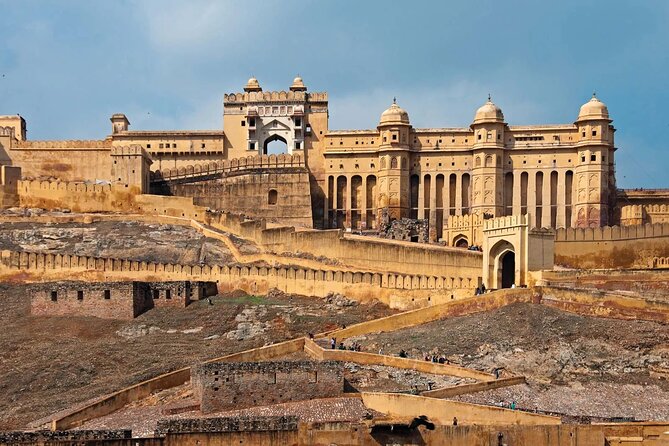
Amber Fort : Built on the hilltop outside Jaipur, the construction of the Fort was started by Raja Man Singh in the 16th century and was completed by Sawai Jai Singh in the 18th century. Set in a picturesque background, the splendid Amber Fort offers magnificent views of the surrounding area. Built in red stone and white marble, the Fort is a represents a fine blend of Mughal and Rajput architecture.
City Palace Museum : The City Palace Museum in Jaipur is divided into three sections namely textile museum, arms museum and art museum. As one enters the City Palace area, the first museum that falls on the way is the textile museum that houses a number of garments and ornaments worn by the kings and other members of the royal family in the departed era. The major highlight of this museum is a garment worn by Sawai Raja Madho Singh II. It is said that as he had a bigger body frame, the cloth used for this garment was 190 meters of cloth.
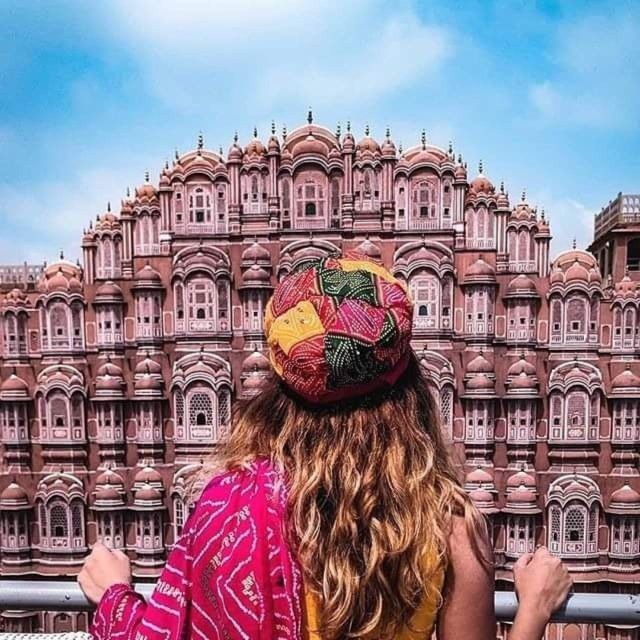
Hawa Mahal : Hawa Mahal, literally the Palace of Winds, built in 1799 by Maharaja Sawai Pratap Singh, situated at Sierh Deori bazar displays fanciful architecture and is a remarkable landmark of Jaipur. So named because the palace has specially latticed screens and arches for an unbridled flow of the air currents but is a set pattern with the passage of the sun.
Jal Mahal : Jal Mahal was built by Sawai Pratap Singh in 1799 AD in the midst of the Man Sagar Lake as a pleasure spot. It is Jaipur's lake palace surrounded with water. It is built for royal duck shooting parties. The Lake was formed by constructing a dam between the two hills by Sawai Man Singh I. During the winter months one can see a large number of migratory birds at the lake. Jal Mahal Palace (Water Palace) has subsided under the mud and silt of the lake it used to look over.
Jantar Mantar : Emperor Sawai Jai Singh II, the builder of the city has to his credit five observatories in different parts of the country. The one he raised at Jaipur is the largest and best preserved. Huge instruments in intricate masonry offer an accurate measurement of the time, the declination of the sun, the altitude and the azimuth, the position of constellations in the sky for the day, the eclipses and the allied astronomical phenomena.
BM Birla Planetarium : The Birla Planetarium is at the BM Birla Science & Technology Center, near Statue Circle. The Planetarium offers unique audio-visual educational and entertainment with its modern computerised projections system.